About UBINIG
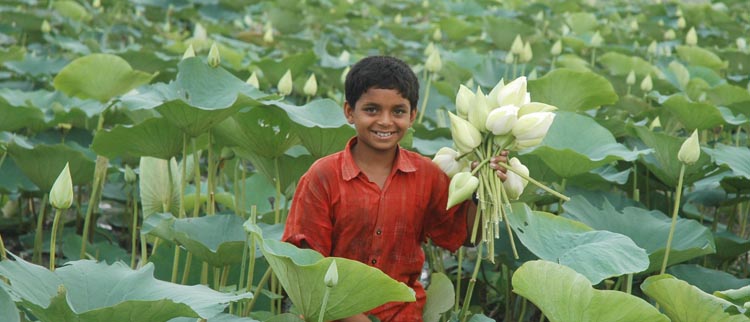
This page is to introduce UBINIG (Policy Research for Development Alternative) and its various activities. UBINIG is a policy and action research organization in Bangladesh, formed in 1984 by a group of activists to support peoples' movement for social, economic, political and cultural transformation. Originating as a study circle searching for alternatives to the mainstream development intervention, it soon became an organisation enabling communities to solve their problems of life and livelihood and articulating and advocating on their behalf for positive change at the policy level. The objective was to make policy making oriented to people and the process more transparent and inclusive serving the interest of the majority of the people.
UBINIG stands against all forms of predatory interventions and hierarchical relations destroying conditions of life. livelihood and the joy of living, foreclosing the possible unity among people across diverse cultures and geographies.
By defending dignity, diversity, livelihood and communities We are working to create an authentic global community where we all can live in peace and joy.
(Read More)
Narigrontho Prabartana
Narigrantha Prabartana is Women’s Resource Centre and runs a bookstore. It is a place for women and also an active space for social activism and policy advocacy. By its very presence as a Women Book Store and intellectual resources for activist women, Narigrantha symbolises resistance against patraiarchy. Women from any backgropund can meet, interact and organize their own events through Narigrantha Prabartana.
Narigrantha Prabartana keeps books published by different organisations, individuals and publishers. These are available to purchase or read. As a publisher, Narigrantha Prabartana publishes books, pamphlets, posters and other important research works to facilitate women’s movement.
(Read More)
Sramobikash Kendra
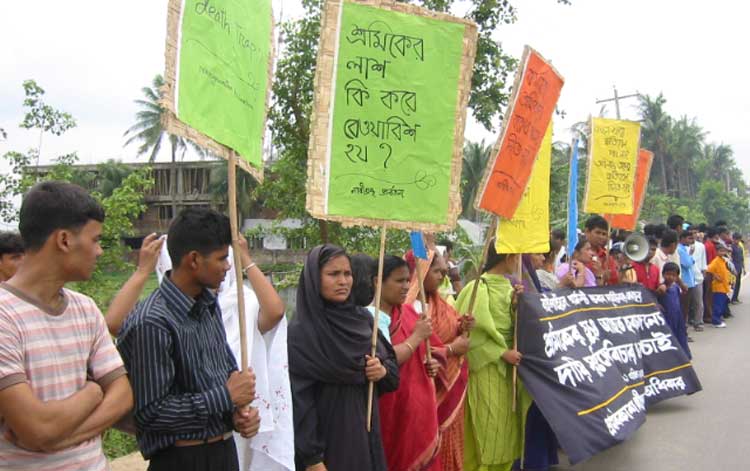
Sramabikash Kendra: Defending Worker’s Rights
Sramabikash Kendra is the trade union and development education wing of UBINIG. In English the name translates into “Centre for Labour Education and Development”. It aims to bridge the gap between research and worker’s initiatives to develop healthy environment in trade union activities of Bangladesh.
Apart from trade union and development education, Sramabikash Kendra plays strong advocacy role with regard to policies that affect the lives of workers. It also plays crucial catalytic role in generating discussions and debates, particularly among the general workers and the trade union leaders on the issues of industrialisation and trade union issues.
Since 1986, UBINIG is active among workers with special attention to women. The emergence of female labours in garment sector has been noticed since 1985 but the major inflow occurred during the decade of eighties and continuing until to day. For a long time women-workers remained unnoticed by the development organisations. The workers were not aware of the legal rights to form unions and improve working conditions. There were particular gaps existed in the works of the trade unions to address the question of female workers. The policy of export oriented industrialisation relaxed factory regulations and labour laws. Therefore, it was necessary to understand the situation of the workers in garment industries, shrimp processing industries and informal sector thoroughly to undertake policy measures for improved working condition and factory management as well as to ensure the right of the workers.
The effects of Structural Adjustment and lending policies of multilateral agencies, especially privatisation, deregulation and de-unionisation of the workers of Bangladesh are the key research concern of Sramabikash Kendra. It also monitors the WTO negotiations, particularly Labour Standard debates and Social Clause issues and informs the workers about the possible consequences of liberalised international trade and agreements.
(Read More)
Nobopran Andolon

Nobopran Andolon is a cultural movement in Bangladesh that reclaims popular philosphical discourses often known as Bhokti-Sufi-Boyati traditions. These cultural and oral knowledge practices has been ceaselessly challenging various forms of hierarchical oppression such as caste, class and patriarchy. These movements are generally grounded upon the philosophy of love, care and responsibility to others and oppose all forms of violence and oppression. Through poetry, music and theatrical performance Bhokti-Sufi-Boyati traditions play powerful role in defining the meaning of community and community relations till today.
Nobapran Andolon works closely wth Nayakrishi Andolon, the biodiversity-based ecological movement.
(Read More)
TABINAJ (Anti-tobacco Alliance of Women)
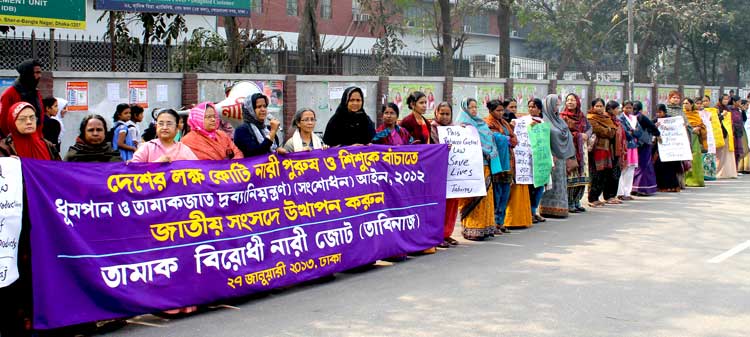
Tamak Birodhi Nari Jote (TABINAJ) is the first anti-tobacco alliance of women in Bangladesh which has taken up anti-tobacco campaign to save women, men and children from the hazards of tobacco. It is against smoking and use of smokeless tobacco products which are mostly consumed by women. The Alliance is against tobacco cultivation and use of women and child labour in the hazrduous biri industry. Tabinaj is actively lobbying for Law Amendment of the Tobacco Control Law for its effective implementation. Tabinaj member organisation are working in over 43 districts of Bangladesh.
(Read More)
Shasthya Andolon
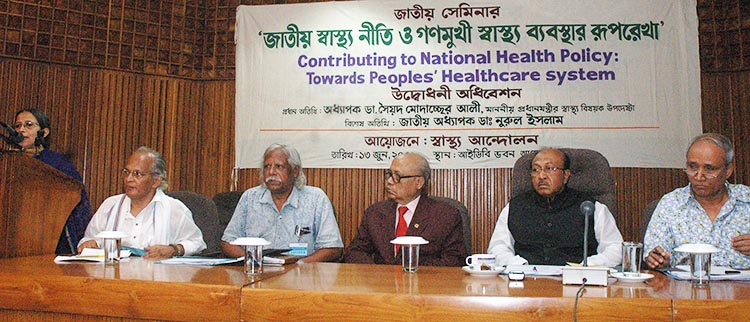
Shashtya Andolon is a network of health activists, researchers, health practitioners, professionals environment and women's organisations. UBINIG is the secretariat of this network since its inception in 2000. Shashtya Andolon has been very effective in mobilising public opinion for a pro-people health policy to be declared and implemented by the government. It also organises campaign on public health issues by organising seminars, holding demonstrations etc.
(Read More)
Community Biodiversity Management (CBM)
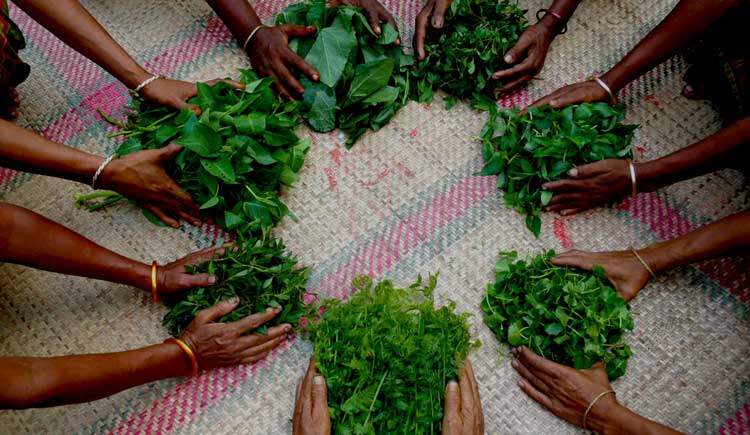
The Community Biodiversity Management is a Nayakrishi farmers' programme, which is carried out as a part of Community-Based Biodiversity Management South Asia Programme coordinated by Local Initiatives for Biodiversity, Research and Development (LI-BIRD), Nepal. Nayakrishi farmers are organised to document, conserve and utilize their genetic resources and associated knowledge through the Nayakrishi Seed Network (NSN) to protect farmers’ rights and secure access and control over their genetic resources. Through this initiative Nayakrishi farmers are carrying out Participatory Variety Selection (PVS) for Aus Rice in three agro-ecological zones. Nayakrishi farmers in Shahzadpur are using the community knowledge and skills to protect against river erosion by making Chatka - bamboo binding in the river island of Jamuna. This Chatka protected over 142 families and helped accretion of 100 acres of land.
(Read More)
Bangladesh Food Safety Network (BFSN)
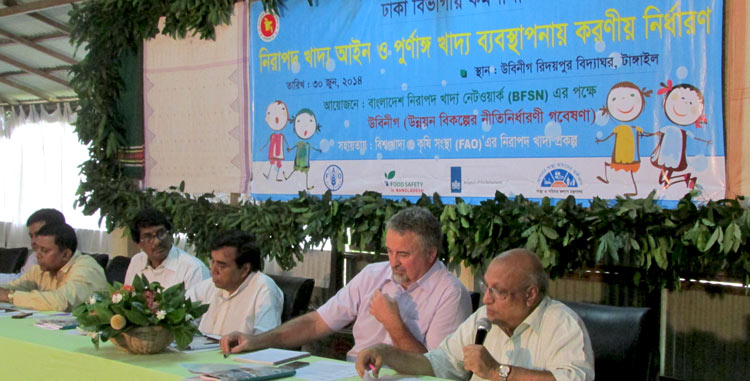
The Bangladesh Food Safety Network (BFSN) was formed following a two-day workshop entitled Building a Food Safety Network in Bangladesh in November 2010. The founding member organizations of BFSN include CAB (Consumer Association of Bangladesh), UBINIG (Policy Research for Development Alternative), Shisuk, B Safe Foundation and Hunger Free World. .
The overall objective of the Workshop was for consumer organizations and like-minded NGOs working on food safety issues and public concerns to explore the potential of forming a Food Safety Advocacy and Awareness Network in Bangladesh. Eighty-three representatives from various Civil Society Organisations (CSOs)/NGOs and Consumer Organisations in Bangladesh participated in the Workshop. These organizations are working primarily on food safety issues in the areas of consumer education, monitoring and food product testing, advocacy, research and grassroots mobilisation. Through the carefully planned and presented workshop, participants identified the need to unite to move forward with initiatives to improve food safety.
(Read More)
Coalition Against Bt. Brinjal, Bangladesh
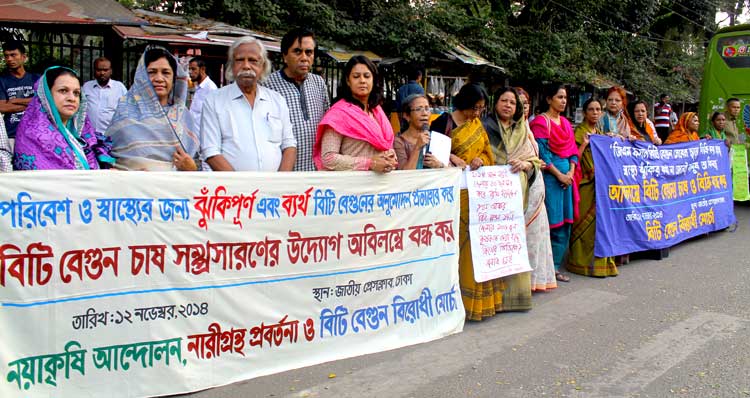
Coalition Against Bt. Brinjal, Bangladesdh (Bt Begun Birodhi Morcha) is an alliance of various environmental and social groups and individual scientists, intellectuals, journalists, lawyers and women and health activists. It has been protesting against the approval of Bt. Brinjal in Bangladesh which poses threat to human health, biodiversity, environment and mostl importantly farmers' rights. The Coalition calls upon the government to revoke the approval and take appropriate measure to ensure safety of human health, preserve diversity of local variety brinjals and ensure farmers rights.
(Read More)